Best WiFi Planning Software in 2026
Five tools cover very different jobs, from planning a small office to modeling a multi-floor enterprise WLAN. NetSpot takes first place for its useful mix of price, planning depth, plus field-survey features.
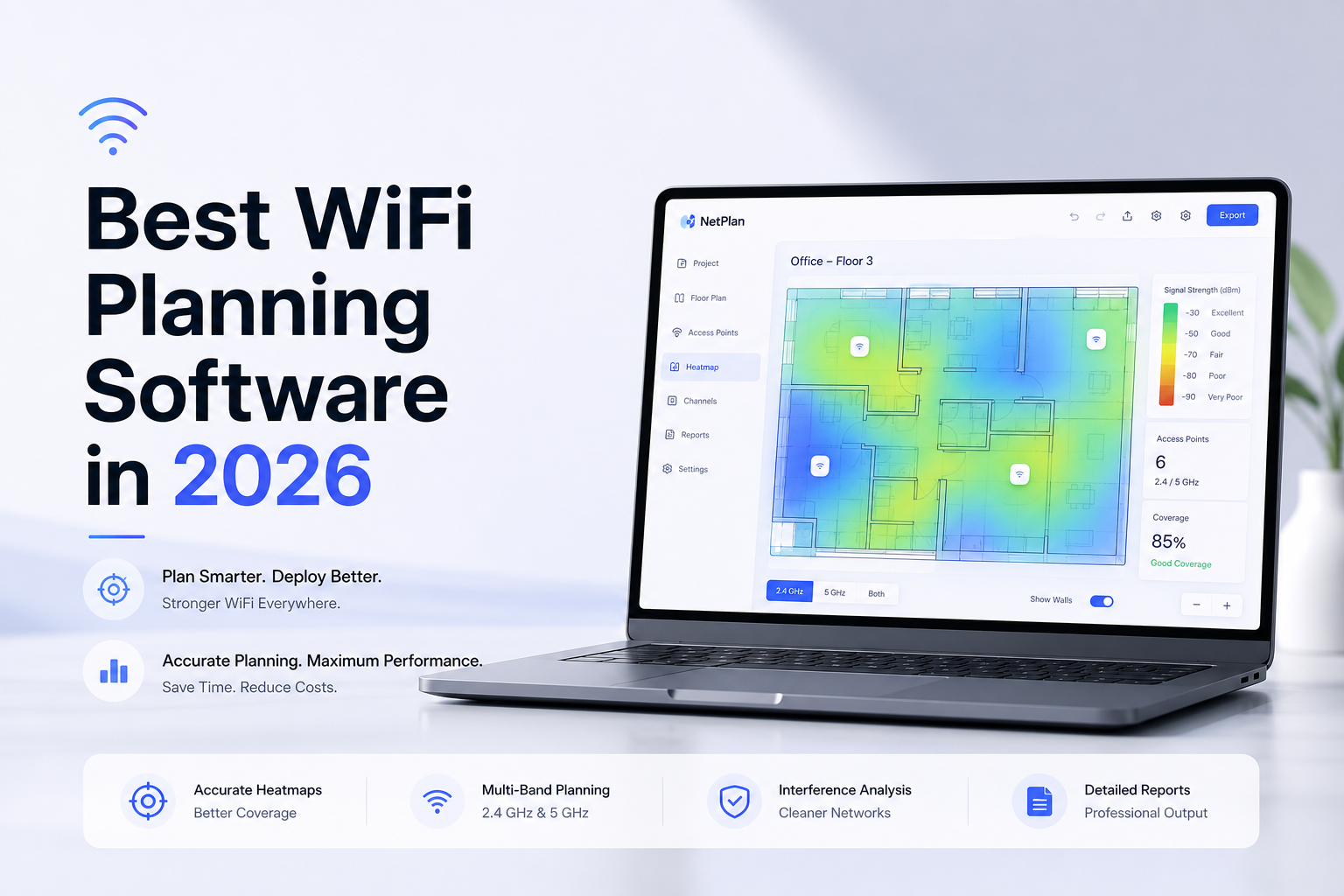
NetSpot is the best WiFi planning software for most buyers in 2026. It combines predictive heatmaps, live network inspection, plus field surveys in a $199 desktop package, giving small IT teams much of what they need without a recurring per-user fee.
NetSpot
9.2/10Best for: Small IT teams, consultants, plus property managers needing planning, surveys, heatmaps, or troubleshooting in one app
- Predictive planning plus real-world surveys in one application
- One license works on Windows or macOS desktops
- Supports Wi-Fi 7 plus the 6 GHz band
- Clear heatmaps that do not require deep RF training to interpret
Hamina Network Planner
8.9/10Best for: Distributed network teams designing Wi-Fi, IoT, wired infrastructure, or private cellular systems
- Runs in a browser with no desktop installation
- Strong multi-floor plus 3D modeling tools
- AI-assisted wall or object drawing
- Interactive reports are easy to share
Ekahau AI Pro
8.7/10Best for: Full-time wireless engineers designing business-critical networks where measurement hardware plus mature RF workflows matter
- Deep predictive design controls
- Large AP plus antenna model library
- AI-assisted placement for complex requirements
- Strong survey-data analysis workflow
Best WiFi Planning Software for 2026 Compared
These five tools are compared by Wi-Fi 7 modeling, field-survey support, published pricing, plus overall usefulness for their intended buyer. Scores reflect editorial judgment rather than a controlled RF accuracy benchmark. The reviews below explain each rating plus the tradeoffs behind it.
| Tool | Wi-Fi 7 | Field Surveys | Price | Score |
|---|---|---|---|---|
| 1. NetSpot PICK | ● Yes | ● Yes | $199 one-time | 9.2/10 |
| 2. Hamina Network Planner | ● Yes | ● No | $980/yr | 8.9/10 |
| 3. Ekahau AI Pro | ● Yes | ● Yes | $7,990 first year | 8.7/10 |
| 4. TamoGraph Site Survey Pro | ● Yes | ● Yes | $999/yr | 8.4/10 |
| 5. UniFi Design Center | ● Yes | ● No | Free | 7.8/10 |
The 5 Best WiFi Planning Software Tools, Reviewed
01 NetSpot
Windows, macOS, Android, iOS · Etwok
9.2/10
NetSpot
Windows, macOS, Android, iOS · Etwok
NetSpot offers the most practical middle ground in this group. The Pro edition combines predictive planning, live inspection, on-site surveys, plus reporting without pushing buyers into a four-figure annual contract. Its current desktop release supports Wi-Fi 7, including 2.4, 5, plus 6 GHz analysis.
The planning workspace includes 9 predictive visualizations. Pro projects can hold 50 zones, 50 snapshots, plus 500 data points per snapshot. Those limits are enough for typical offices, schools, stores, or multi-unit properties, though very large consultants may need Enterprise.
The free edition is useful for inspecting nearby networks, but planning is only a demo there. Serious floor-plan modeling requires Pro. Even so, the $199 one-time price makes the paid step easier to justify than the recurring fees attached to several enterprise tools.
Best forSmall IT teams, consultants, plus property managers needing planning, surveys, heatmaps, or troubleshooting in one app
- Predictive planning plus real-world surveys in one application
- One license works on Windows or macOS desktops
- Supports Wi-Fi 7 plus the 6 GHz band
- Clear heatmaps that do not require deep RF training to interpret
- Far cheaper than enterprise survey suites
- Free edition offers only a planning demo
- Pro project limits may restrict high-volume survey firms
- Spectrum analysis can require extra hardware

02 Hamina Network Planner
Browser-based · Hamina Wireless
8.9/10
Hamina Network Planner
Browser-based · Hamina Wireless
Hamina is a strong choice when several people need to review the same design without passing large project files around. It runs in a browser, models multi-floor buildings, places unlimited APs on paid plans, plus produces interactive 2D or 3D reports.
The Planner tier covers Wi-Fi 7, BLE, Zigbee, EnOcean, wired closets, cabling, plus switch placement. AI-assisted drawing can identify walls, elevators, or shelves, which saves time on clean architectural plans. The free account permits only 3 simulated APs, so it works better as an evaluation tool or project viewer.
At $980 per user each year, Hamina costs much more than NetSpot. The tradeoff is better collaboration, deeper building modeling, plus broader wireless technology coverage. On-site validation needs a separate Hamina survey product rather than the basic Planner subscription.
Best forDistributed network teams designing Wi-Fi, IoT, wired infrastructure, or private cellular systems
- Runs in a browser with no desktop installation
- Strong multi-floor plus 3D modeling tools
- AI-assisted wall or object drawing
- Interactive reports are easy to share
- Includes wired network planning
- Annual per-user pricing adds up quickly
- Planner does not include on-site surveys
- Free account is limited to three simulated APs
03 Ekahau AI Pro
Windows, macOS, browser · Ekahau
8.7/10
Ekahau AI Pro
Windows, macOS, browser · Ekahau
Ekahau AI Pro remains the heavy-duty option for complex enterprise work. It handles predictive design, survey-data inspection, upgrade simulations, plus custom reporting across 2.4, 5, or 6 GHz networks. Its large AP plus antenna library is particularly useful when designs involve directional antennas or mixed vendors.
The software can automate many AP placement iterations, though experienced engineers still need to check capacity assumptions, wall losses, mounting heights, plus channel plans. Ekahau becomes much more capable when paired with Sidekick hardware for consistent tri-band measurements or spectrum collection.
Cost is the major barrier. A listed $5,995 AI Pro license requires a first-year Connect subscription commonly listed at $1,995, putting the initial software commitment near $7,990 before survey hardware. That can make sense for a busy WLAN practice, but it is excessive for occasional office layouts.
Best forFull-time wireless engineers designing business-critical networks where measurement hardware plus mature RF workflows matter
- Deep predictive design controls
- Large AP plus antenna model library
- AI-assisted placement for complex requirements
- Strong survey-data analysis workflow
- Good fit for repeat enterprise projects
- High initial software cost
- Connect subscription is required with a new license
- Full field workflow may involve costly Sidekick hardware
04 TamoGraph Site Survey Pro
Windows, macOS · TamoSoft
8.4/10
TamoGraph Site Survey Pro
Windows, macOS · TamoSoft
TamoGraph combines planning with several field-validation methods. Pro supports predictive models, passive surveys, active throughput tests, GPS-assisted outdoor work, plus optional spectrum collection. It also supports 802.11be Wi-Fi 7.
The reporting choices include PDF, HTML, plus ODT. Automatic AP location, vendor antenna patterns, custom wall properties, plus capacity visualizations make it suitable for detailed commercial jobs. A compatible wireless adapter is needed for passive surveys, while spectrum work requires separate hardware.
Pricing gives buyers several ways in. Pro costs $499 for six months, $999 for one year, or $1,999 for the regular license. The short license is handy for a fixed deployment project, though NetSpot remains more approachable for recurring light-duty work.
Best forConsultants needing predictive plans, throughput testing, passive surveys, spectrum data, or outdoor GPS mapping
- Predictive, passive, active, plus spectrum workflows
- Six-month license suits temporary projects
- GPS support for outdoor surveys
- Wi-Fi 7 support
- Detailed report export options
- Passive surveys may require a supported adapter
- Spectrum hardware costs extra
- Interface has a steeper learning curve than NetSpot
05 UniFi Design Center
Browser-based · Ubiquiti
7.8/10
UniFi Design Center
Browser-based · Ubiquiti
UniFi Design Center is the easiest free option here if the final deployment will use Ubiquiti hardware. Users can import a floor plan, draw walls, place UniFi access points, then view estimated coverage while adjusting mounting positions or device models.
The redesigned 2026 version adds browser-based collaboration plus a broader digital twin view of the site. It can model Wi-Fi alongside switches, cameras, racks, plus related UniFi equipment. The license cost remains $0.
This is not a neutral professional survey suite. AP selection is tied to the UniFi catalog, while post-installation field surveys require another tool. It is still useful for a home, café, small office, or straightforward UniFi refresh where an approximate design is better than guessing from a product spec sheet.
Best forUniFi buyers who need a fast coverage estimate plus a bill of materials before ordering hardware
- Completely free to use
- Quick floor-plan workflow
- Useful UniFi hardware list plus placement view
- Browser access supports easy sharing
- Good for early budget estimates
- Limited to the UniFi ecosystem
- No independent field-survey workflow
- Less RF control than specialist planning tools
How We Evaluated the Best WiFi Planning Software for 2026
Each tool was evaluated using the same practical checklist: predictive RF modeling, wall attenuation controls, multi-floor support, Wi-Fi 7 readiness, AP catalogs, reporting, survey capability, platform coverage, plus current published pricing. We gave extra weight to whether the software can carry a project from an imported floor plan through post-installation validation.
The scores are editorial assessments, not laboratory measurements of propagation accuracy. RF output depends heavily on floor-plan scale, material values, antenna patterns, mounting height, client requirements, plus the quality of field measurements. A polished heatmap built from poor assumptions is still a poor design.
How to Choose WiFi Planning Software for Your Network Projects
Start with the job rather than the longest feature list. A small office may need floor-plan modeling, basic wall types, plus a coverage check. A hospital, warehouse, school, or stadium may require capacity rules, directional antenna patterns, multiple floors, client-density modeling, spectrum analysis, plus formal validation reports.
Check licensing carefully too. One-time software can be cheaper for occasional work, while subscriptions may provide collaboration or continually updated AP libraries. If client work is involved, confirm that the license permits commercial use plus that exported reports can carry your own branding.
Common WiFi Planning Software Mistakes to Avoid
The biggest mistake is treating predicted signal strength as proof that a network will work. Coverage does not guarantee capacity, roaming, low contention, or acceptable voice performance. Set design requirements before placing APs, then validate the finished network with a site survey.
Wall attenuation deserves attention as well. Generic drywall values can be far off in old buildings, warehouses, fire-rated corridors, or rooms lined with shelving. Measure representative walls when possible. Also avoid importing a floor plan without setting its scale, since one bad distance reference can distort the entire RF model.
Which WiFi Planning Tool Should You Choose?
NetSpot earns the top spot because it joins predictive planning, surveys, troubleshooting, plus clear heatmaps at a manageable one-time price. Hamina is better for browser collaboration or advanced 3D building work, while Ekahau suits established enterprise WLAN practices. Choose TamoGraph for varied field-survey methods, or UniFi Design Center for a free Ubiquiti-only draft.Model one representative floor with your top two choices before buying, then compare the setup time, wall controls, report quality, plus AP catalog against the work you actually do.