Best AI Detectors for Edited Text: Results from Clever AI Detector’s Benchmark
Raw chatbot output is the easy test. This ranking focuses on what happened after a person, editor, or paraphrasing model changed the text.
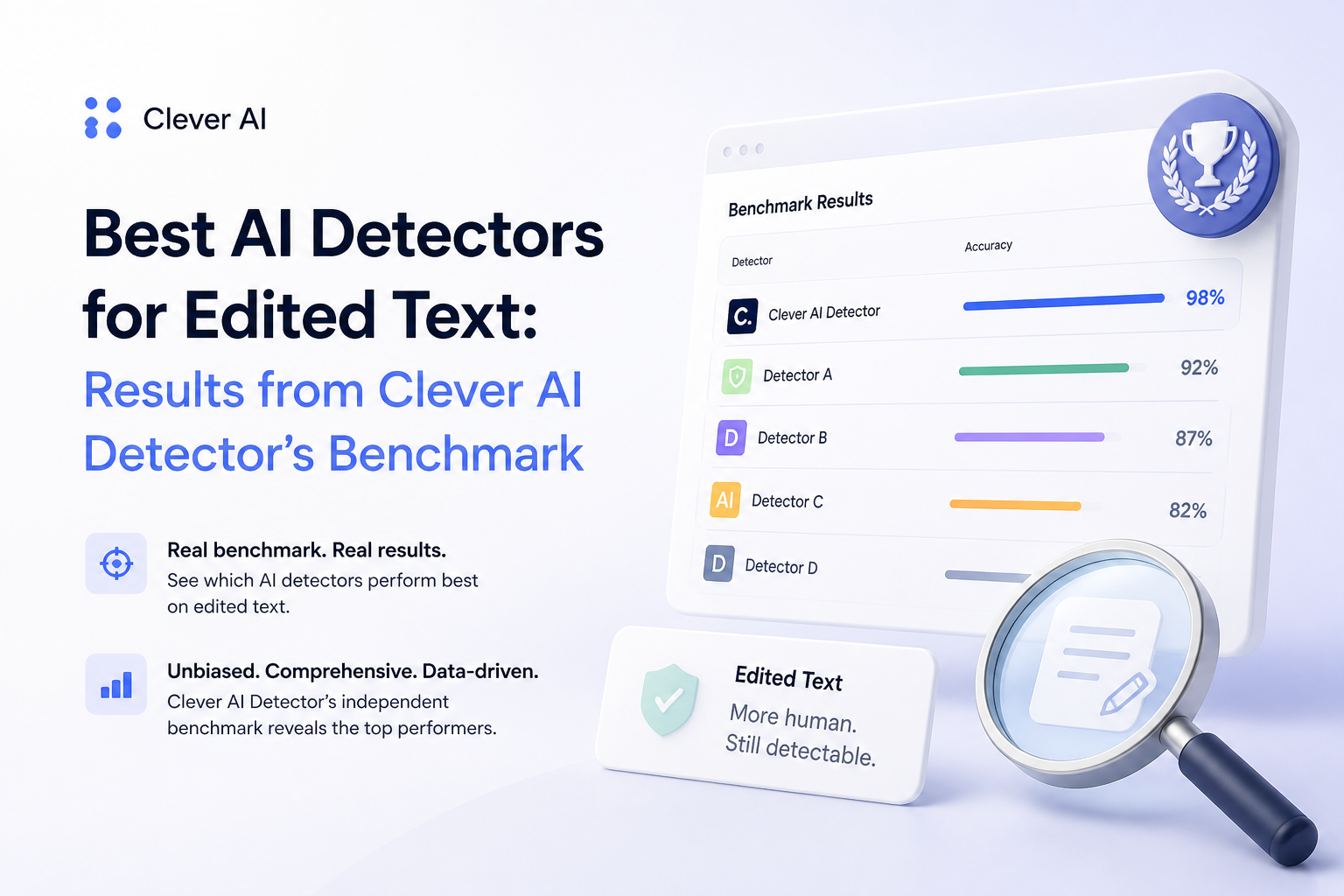
Clever AI Detector
9.2/10Best for: Editors, teachers, or writers checking AI-assisted text after grammar fixes, rewriting, or paraphrasing
- 96.7% overall detection rate in the featured benchmark
- 92.0% detection on humanized AI text
- 94.7% detection on AI-edited human drafts
- Free sentence-level analysis with no required signup
Copyleaks
9.0/10Best for: Schools, agencies, or teams that need strong edited-text detection plus multilingual scanning
- Highest humanized-text detection rate in the benchmark
- 95.0% overall detection across 600 AI-involved essays
- AI detection offered in more than 30 languages
- Includes plagiarism checks plus browser integrations
Originality.ai
8.4/10Best for: Publishers or content teams reviewing human drafts polished with generative writing tools
- 96.0% detection on AI-improved human writing
- Perfect result on direct AI plus machine-rewritten essays
- Three limited free scans per day are available
- Useful website scanning plus team organization features
AI Detectors for Edited Text Compared
The table compares each detector's results on AI-improved human drafts plus adversarially humanized AI essays in CleverFiles' August 2026 GEDE benchmark. Scores are editorial judgments rather than additional laboratory metrics, with the reasoning laid out in the reviews. ([cleverhumanizer.ai](https://cleverhumanizer.ai/best-ai-detectors))
| Tool | AI-Edited Drafts | Humanized AI | Price | Score |
|---|---|---|---|---|
| 1.Clever AI Detector PICK | ● 94.7% | ● 92.0% | Free | 9.2/10 |
| 2.Copyleaks | ● 86.7% | ● 93.3% | $13.99/mo | 9.0/10 |
| 3.Originality.ai | ● 96.0% | ● 51.3% | $12.95/mo | 8.4/10 |
| 4.Winston AI | ● 86.0% | ● 44.7% | $10/mo | 7.9/10 |
| 5.GPTZero | ● 1.3% | ● 73.3% | Free | 7.3/10 |
The 5 Best AI Detectors for Edited Text, Reviewed
01 Clever AI Detector
Web app / CleverFiles
9.2/10
Clever AI Detector
Web app / CleverFiles
Clever AI Detector ranked first in CleverFiles' August 2026 GEDE benchmark. It caught 96.7% of 600 AI-involved essays, including 94.7% of AI-edited human drafts plus 92.0% of humanized AI essays. Its weakest-category result was the best of the eight tools tested. (cleverhumanizer.ai)
The practical difference is in the report. You get an overall probability, confidence context, plus sentence-level signals instead of a bare accusation. Checks support 80 to 10,000 words, cost nothing, plus require no account. That makes repeat checks easy, though the detector currently focuses on English. (cleverhumanizer.ai)
Best forEditors, teachers, or writers checking AI-assisted text after grammar fixes, rewriting, or paraphrasing
- 96.7% overall detection rate in the featured benchmark
- 92.0% detection on humanized AI text
- 94.7% detection on AI-edited human drafts
- Free sentence-level analysis with no required signup
- Accepts up to 10,000 words per check
- English is the only listed language
- No detector score can establish authorship
- Benchmark data comes from the product's own company, despite using a public external corpus
02 Copyleaks
Web platform / Copyleaks
9.0/10
Copyleaks
Web platform / Copyleaks
Copyleaks nearly tied the winner overall. It caught 95.0% of all AI-involved essays plus 93.3% of humanized AI text, the top result in that difficult category. Its lowest category was AI-improved human writing at 86.7%. (cleverhumanizer.ai)
This is the more developed team platform of the top two. Personal plans include AI plus plagiarism checks, browser tools, saved scans, file uploads, plus detection in over 30 languages. The tradeoff is cost. Annual Personal billing starts at $13.99 per month, while monthly billing is $16.99. (copyleaks.com)
Best forSchools, agencies, or teams that need strong edited-text detection plus multilingual scanning
- Highest humanized-text detection rate in the benchmark
- 95.0% overall detection across 600 AI-involved essays
- AI detection offered in more than 30 languages
- Includes plagiarism checks plus browser integrations
- Batch file scanning suits recurring review work
- Costs more than the free winner
- AI-improved detection trailed Clever AI Detector
- Credit limits require some usage planning
03 Originality.ai
Web platform / Originality.ai
8.4/10
Originality.ai
Web platform / Originality.ai
Originality.ai produced the best AI-improved result in the benchmark at 96.0%. It also caught every directly generated plus machine-rewritten essay in the selected corpus. For editorial teams concerned about AI polishing applied to an otherwise human draft, that profile is useful. (cleverhumanizer.ai)
The weak point was adversarial paraphrasing. Its Lite model detected only 51.3% of humanized AI essays, so it missed nearly half of that category. The paid platform adds file uploads, website scans, team controls, plus shareable reports. A limited detector on the homepage currently offers three free scans per day. (originality.ai)
Best forPublishers or content teams reviewing human drafts polished with generative writing tools
- 96.0% detection on AI-improved human writing
- Perfect result on direct AI plus machine-rewritten essays
- Three limited free scans per day are available
- Useful website scanning plus team organization features
- Sentence highlighting plus writing replay support review work
- Caught only 51.3% of humanized AI text in the tested Lite model
- Paid credits expire according to the selected plan
- The benchmark did not test its heavier detector models
04 Winston AI
Web app / Winston AI
7.9/10
Winston AI
Web app / Winston AI
Winston AI caught 82.7% of the benchmark's 600 AI-involved essays. It detected every direct AI plus machine-rewritten sample, though performance dropped to 44.7% on humanized text. It also became less dependable at the shortest plus longest text ranges in this corpus. (cleverhumanizer.ai)
Its broader toolkit may matter more than the fourth-place benchmark result. Winston can inspect AI images, deepfakes, scanned documents, plus handwriting through OCR. The free option is a 14-day trial with 2,000 credits. Annual Essential billing works out to $10 monthly. (gowinston.ai)
Best forReviewers who want text detection, scanned-document OCR, plus AI image analysis in one account
- Perfect detection of direct AI plus machine-rewritten essays in the benchmark
- Text, image, deepfake, plus OCR checks share one service
- Shareable PDF reports are available
- Essential annual plan includes 100,000 monthly credits
- Supports several languages
- Caught 44.7% of humanized AI essays
- Free access expires after 14 days
- Results varied noticeably with text length
05 GPTZero
Web platform / GPTZero
7.3/10
GPTZero
Web platform / GPTZero
GPTZero's result was unusual. It caught 73.3% of humanized AI text, third best in that column, yet only 1.3% of AI-improved drafts plus 7.3% of AI-rewritten essays. Its strict overall detection rate landed at 43.7% on the GEDE subset. (cleverhumanizer.ai)
That does not make GPTZero useless. It offers color-coded sentence analysis, explanations, mixed-document handling, plus writing replay tools. Separate RAID testing cited by GPTZero reported far stronger performance on a broader corpus, which shows how sharply detector rankings can move when the dataset or labeling policy changes. (gptzero.me)
Best forEducators who value sentence highlights, mixed-document labels, plus writing-process evidence
- 73.3% detection on humanized AI essays
- Clear sentence-level highlights plus explanations
- Free plan covers basic checks
- Writing replay can provide process evidence
- Supports English, German, Portuguese, French, plus Spanish
- Weak on AI-edited human drafts in the featured benchmark
- Weak on machine-rewritten human text in the same run
- Performance claims vary greatly between benchmarks
How the AI Detectors for Edited Text Were Tested
This ranking uses the August 2026 benchmark published by CleverFiles for Clever AI Detector. The test submitted 750 English academic essays from the public GEDE corpus to eight live detectors. The set contained 150 direct AI essays, 150 AI-improved human drafts, 150 machine-rewritten human drafts, 150 humanized AI essays, plus 150 pre-ChatGPT human controls. Each document was checked once with default settings. (cleverhumanizer.ai)
Ambiguous labels such as “mixed” were counted as not-AI. That choice lowered results for tools that frequently used a middle verdict. We weighted edited-text performance, weakest-category stability, report usefulness, access limits, plus current verified pricing. The publisher built the highlighted product, so the results should be repeated independently even though the underlying corpus is public.
How to Choose an AI Detector for Edited or Rewritten Text
Start by defining what “edited” means in your setting. A student correcting grammar in a self-written essay presents a different problem from a generated article sent through an adversarial paraphraser. In this benchmark, Originality.ai led the first case at 96.0%, while Copyleaks led the second at 93.3%. Clever AI Detector stayed close in both, which explains its overall lead. (cleverhumanizer.ai)
Then check input length, language coverage, file handling, plus how the report expresses uncertainty. A school may need writing replay or LMS support. A freelance editor may just need a free second opinion. If the decision can affect someone's grade or job, prioritize process evidence over detector confidence.
Common Mistakes When Checking Edited Text for AI
The biggest mistake is testing a short paragraph, seeing a precise percentage, then assuming the number is precise. In the featured run, several detectors lost more than 20 percentage points on texts below 200 words. Another mistake is comparing percentages from different tools as if their scales mean the same thing. They use different thresholds plus verdict rules. (cleverhumanizer.ai)
Avoid repeatedly rewriting honest work merely to make a red score disappear. That can damage the prose without proving anything. Save outlines, revision history, source notes, plus earlier drafts instead. Those records say more about authorship than a classifier ever can.
Which AI Detector Handles Edited Text Best?
Clever AI Detector earned first place because it had no obvious collapse point in this benchmark. Copyleaks was effectively level on overall detection plus slightly better on humanized essays, though Clever performed better on AI-improved drafts while charging nothing.
Originality.ai is worth considering for AI-polished human drafts, while GPTZero offers helpful explanations despite its uneven GEDE results. Pick the tool whose difficult category matches your real material, not the one with the loudest overall accuracy claim.
Test two detectors on a set of documents whose writing history you already know, then record false alarms before screening unfamiliar work.